
The bottleneck nobody sees until it’s too late
A single stalled bag on a conveyor doesn’t stay a single bag for long. Behind it, the line keeps feeding, and within minutes, a minor snag becomes a pile-up, a missed connection, a backlog that ripples across an entire terminal. Airports move enormous volumes of baggage through conveyor networks that are long, fast, and largely unobserved between checkpoints. When something goes wrong on that line, the people responsible for fixing it are often the last to know.
That blind spot is the problem we set out to close.
Why traditional monitoring falls short
Most baggage handling operations still lean on manual oversight or centralized analytics that process data far from where the action happens. Both approaches share the same weakness: they’re too slow and too hard to scale. By the time a disruption is spotted, escalated, and acted on, the conveyor has already moved hundreds of bags past the failure point. Operators often end up reacting to consequences rather than causes.
Operational Intelligence for the Line
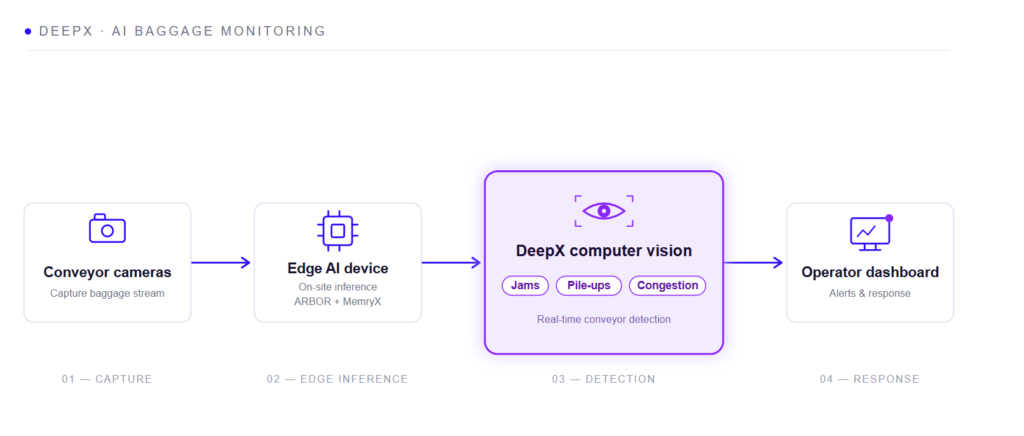
At the center of this solution is what we at DeepX do best computer vision built for real operational conditions. Our technology watches the conveyor system continuously and identifies the conditions that matter, such as baggage jams, pile-ups, and congestion, as they form. Instead of raw camera feeds that still require a human to interpret them, we deliver an immediate, accurate read on what’s actually happening across the baggage flow.
For operations teams, that changes the entire posture from reactive to proactive. The moment a disruption begins, our vision layer surfaces it so a developing jam becomes an early alert rather than a terminal-wide delay. This is the same edge-AI monitoring discipline we apply across our work: putting perception and decision-making as close to the event as possible, where it’s fast enough to act on.
See it in action
It’s one thing to describe real-time detection and another to watch it work. In the demo below, our vision layer tracks bags as they move along the belt and flags a forming pile-up the moment it develops, exactly the kind of early signal that lets operators step in before a single stalled bag turns into a terminal-wide delay.
Built to run where it matters at the edge
Detection only delivers value if it runs reliably in the environment it’s meant to serve, and baggage handling areas are unforgiving with vibration, dust, tight spaces, and round-the-clock operation. Our vision technology runs on ARBOR’s ARES-1983H-AI, an industrial-grade edge AI platform purpose-built for 24/7 duty in exactly these harsh, space-constrained conditions, engineered for maintenance-free performance.
Inference is accelerated by MemryX and its MX3 M.2 AI Accelerator Module, which delivers high-performance, energy-efficient processing at the edge with low latency backed by a public SDK and open-source model that streamlines deployment. Together, the hardware partners give our intelligence layer a fast, durable foundation; the result is end-to-end visibility across the baggage handling process, delivered as real-time alerts and clear dashboards operators can act on instantly.
Building Smarter Airport Infrastructure
The architecture is designed to scale. The solution deploys across terminals and leaves room to grow through future AI upgrades and cloud integration, so the system airports install today can keep getting smarter without being rebuilt. For decision-makers, that means measurable gains in operational efficiency and a smoother passenger experience.
For us, baggage flow is one expression of a broader conviction that the most valuable place for AI in operations is right at the edge, watching the process in real time and turning what was invisible into something you can act on.
It’s time to work smarter
Baggage teams tell us the alert usually arrives after the pile-up, not before. Is that your experience, or has someone solved it? Book a call and we will walk through where the detection window sits.