
How smaller airports can gain operational visibility without taking on the cost and complexity of a mega-hub system
Regional airports rarely need a smaller copy of a mega-hub technology stack. But they still face many of the same operational questions.
Why did the turnaround take longer than planned? When did the handling equipment actually arrive? How long was the service route blocked? What happened before a safety exception? Is the same issue appearing across different shifts or stands?
The answers often exist somewhere between CCTV footage, flight systems, radio communication, reports, and the experience of the people on duty. The problem is not always a lack of data. It is the time and effort required to turn that data into a clear answer.
This is where computer vision can play a practical role. It can turn visible activity into events, timestamps, and searchable evidence, helping airport teams understand what is happening while the information can still support a decision.
The aim is not to give people another platform to manage. It is to make better use of the infrastructure already in place.
The same operational questions, with different economics
Passengers and airlines expect safe, predictable, and efficient operations regardless of airport size. Ground handlers still work against turnaround milestones. Turnaround monitoring matters at ten stands as much as it does at a hundred.
Safety requirements, service commitments, and reporting expectations do not become lighter because an airport handles fewer flights.
Smaller operations may also have less room to absorb disruption. One delayed vehicle, an occupied stand, or a missed handover can affect a meaningful part of the day’s schedule.
At the same time, regional airports often have fewer people available to monitor processes and less appetite for long, infrastructure-heavy technology programmes. Teams compensate through experience, radio calls, manual observations, and spreadsheets. The work gets done, but management is left with gaps when it needs to understand why a delay occurred, how long a resource was unavailable, or whether the same issue keeps returning.
Many airport technology platforms were built around the scale and budgets of major hubs. Regional airports need a more proportionate starting point: enough visibility to improve a real process, without committing immediately to an airport-wide transformation.
The camera network already sees the operation
CCTV is usually treated as a security and evidence infrastructure. It becomes especially important after an incident, complaint, or operational disruption. During an ordinary shift, however, the same cameras are already observing aircraft arriving at the stand, ground equipment moving into position, baggage activity beginning, vehicles using service routes and objects remaining where they should not.
Most of that information stays inside the recorded video. Unless someone is watching the right screen or later searches through the footage, it cannot easily support the operation.
Computer vision changes the role of the camera by converting selected visual activity into structured events. A system can be configured and validated to record that equipment arrived at a stand, a vehicle entered a defined area, an activity began, or an object remained in a restricted zone longer than expected.
Take a belt loader as a simple example. Detecting it is not the business outcome. The useful information is when it arrived, how long it remained, whether baggage activity started as expected, and whether its timing affected the wider turnaround.
That distinction matters. Businesses do not invest in a detection; they invest in a better operational outcome.
The original video can remain available when evidence is needed. The difference is that teams can reach the relevant moment through an event or timestamp instead of beginning with a long manual review.
Recorded video drives operational decisions
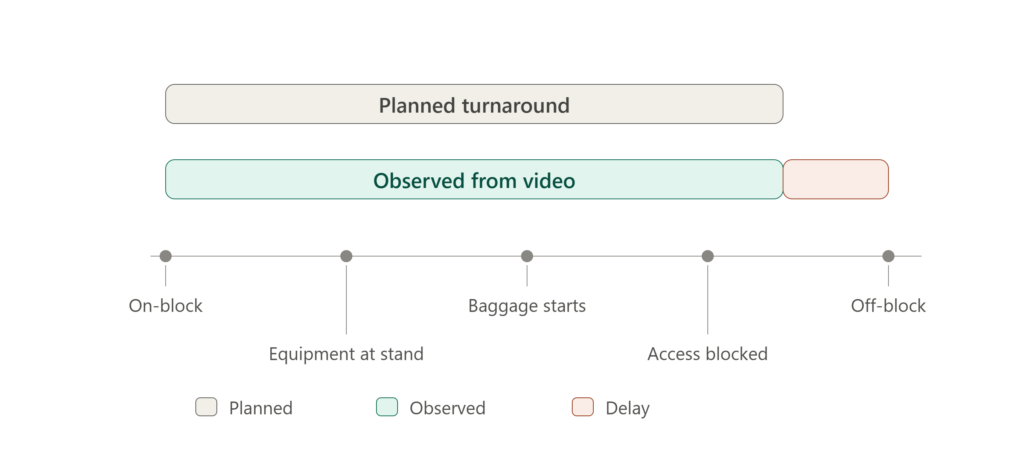
A turnaround is a sequence of connected activities. A small delay early in the process can influence several tasks that follow, yet a final delay code rarely tells the full story. Turnaround monitoring is an attempt to describe that sequence while it happens.
A video-based timeline can add the missing context. It might show when the aircraft arrived, when the required equipment became available, when visible handling activity began, how long selected stages continued, and whether another vehicle or obstruction affected access.
This allows the team to move from “the turnaround was late” to “this is where the process first moved away from plan.”
During the shift, that information can help a supervisor focus on an exception instead of calling several people to establish the current situation. After the shift, it can shorten incident review, airline queries, and performance discussions. Over time, consistent event data can reveal patterns in stand occupancy, equipment waiting time, route congestion, and resource utilisation.
It also gives the airport, airline, and ground handler a shared reference. The purpose is not to automate blame or remove human judgment. It is to reduce the time spent reconstructing what happened and create a clearer basis for improvement.
A layer that complements existing airport systems
Computer vision should complement the airport’s existing operational and surveillance environment, not try to replace it.
Flight and operational databases, such as AODB, show what was planned or recorded. ADS-B provides aircraft movement information. Flight information, weather, access-control, and incident-management systems add their own parts of the picture. Computer vision contributes information about what is happening on the ground.
When these sources are connected, the airport can compare the planned process, the system record, and the physical reality rather than reviewing each one separately.
For technical teams, the architecture can be adapted to security, data-protection, and infrastructure requirements. Processing may happen close to the cameras, on airport-controlled servers, or in a selected cloud environment. Processing close to the source, commonly called edge processing, can reduce response time and the amount of video moving across the network. Depending on the use case, the central system may receive event metadata and selected clips rather than every video stream.
Natural-language search can make this information easier to use. A supervisor could ask which turnarounds at a particular stand exceeded the planned time or what happened before a safety exception. The interface may be conversational, but the answer still needs to lead back to recorded events, timestamps, and video evidence. Reliable data remains the foundation.
Start with a single operational question
The strongest starting point is usually one operational question linked to a real decision.
For example: “Why do turnarounds at this stand regularly take longer than planned?”
From there, the airport and technology teams can work backwards:
- Define who needs the answer and what decision it should support.
- Review the workflow, available data, and existing camera coverage.
- Agree on which visible events matter and how success will be measured.
- Test the approach using representative footage and real operating conditions.
- Validate the result with the people who understand the operation before expanding it.
This step is essential because computer vision cannot reliably analyse an event that the camera does not capture clearly. Camera angle, distance, lighting, weather, image quality, night-time conditions, and objects blocking the view can all influence the result. The same activity may also look different across stands or service providers.
A pilot should therefore measure more than detection accuracy. The practical questions are just as important: Does the information arrive when the team can still act? Are the alerts relevant? Can users find evidence faster? Does the output improve a real operational decision?
Sometimes the existing camera setup is enough. Sometimes another camera angle, an additional data source, or a change in workflow is needed. And sometimes, computer vision is not the right answer for that particular process. Finding this out early is part of a useful assessment, not a failed result.
What this could change for regional airports
Reusing existing cameras can lower the barrier to starting, but the larger value appears when the first validated workflow becomes a foundation for others.
An airport might begin with turnaround visibility and later consider stand occupancy, equipment utilisation, service-road exceptions, or selected safety events. Each workflow can build on the same camera network, event history, and integration layer. Turnaround monitoring is simply the workflow that usually comes first.
This can reduce the time spent searching footage, make operational KPIs more consistent, support better planning, and give airlines and handlers a clearer evidence base for performance discussions. It also lets the airport invest in stages, expanding around demonstrated value rather than committing to a large platform before the operational case is clear.
Computer vision will not remove the need for core airport systems. It may, however, help smaller airports avoid buying more technology than they need simply to answer a focused operational question.
How DeepX approaches the question
At DeepX, we start with the operation rather than a fixed catalogue of AI functions. What is difficult to see today? Who needs the answer? What would they do differently if the information were available earlier?
We then look at the existing cameras, available data, infrastructure constraints, and real operating conditions. Together with the airport team, we define the events that matter, the limitations that need to be tested, and the evidence required before anyone discusses wider deployment.
Where edge processing is appropriate, CAMBOX PRO→ can analyse video close to the camera network. DXHub→ can bring events, alerts, timelines, and reporting into a common operational view and connect them with other relevant systems. These are implementation tools; the starting point remains the airport’s operational need.
Our role is not only to build what is requested. It is also to help determine what is worth building, what the current infrastructure can realistically support, and what needs to be proven first.
The conversation is worth having
How far can computer vision realistically go in regional aviation? Could it give smaller airports access to useful operational intelligence without forcing them into complex and expensive systems designed for major hubs?
There is no universal answer. It depends on the process, the cameras, the available data, and the decision the airport wants to improve. That is why the most useful conversations usually begin with a real operational situation rather than a product list or finished technical specification.
We would be interested in hearing where airport teams see the largest gap between what their cameras record and what their people can act on. A delayed turnaround, recurring equipment issue, blocked route, or difficult incident review is often enough context to begin comparing perspectives.
Whether the next step is a focused pilot, a camera assessment, or simply the conclusion that computer vision is not the right tool for the case, reaching a clear answer is valuable.